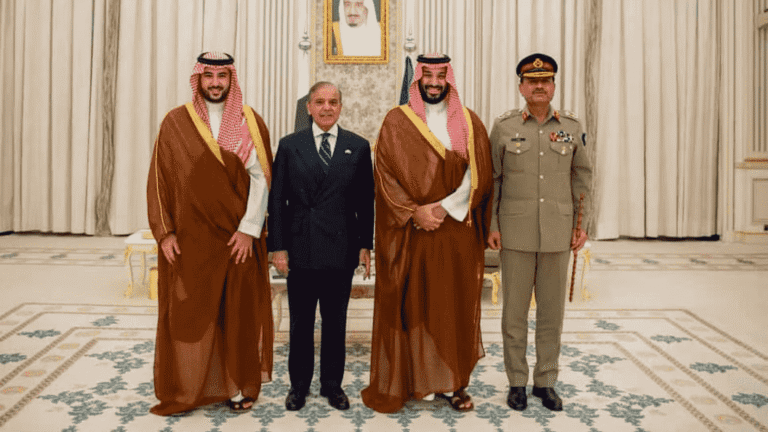
Saudi Arabia and Pakistan have signed a Strategic Mutual Defence Agreement, a landmark pact that could alter security balances across South Asia and the Middle East. The deal, which promises cooperation “by all military means,” is seen as Riyadh’s attempt to diversify its security partners while raising questions about Islamabad’s nuclear deterrence role in the Gulf.
A Shift in Regional Security
While the text of the agreement has not been released in full, both governments have emphasized that the pact commits each to assist the other if threatened. Pakistan’s Defence Minister Khawaja Asif clarified that nuclear weapons are “not on the radar” of the agreement, but analysts remain skeptical about how the pact might interact with Pakistan’s nuclear posture.
For Saudi Arabia, the deal offers access to Pakistan’s military expertise, including conventional forces, training, and intelligence-sharing. For Pakistan, it provides economic and strategic dividends, reaffirming Riyadh’s long-standing role as a financial backer and diplomatic partner.
India’s Cautious Response
India reacted carefully, underscoring its own “wide-ranging strategic partnership” with Saudi Arabia. The Ministry of External Affairs called for respecting “mutual interests and sensitivities,” signaling that New Delhi views Riyadh as a valuable partner despite its outreach to Islamabad. Analysts in Delhi note that India will closely monitor whether the pact translates into operational cooperation that could shift the military balance.
Nuclear Umbrella Debate
The most sensitive question is whether the pact effectively extends Pakistan’s nuclear deterrence to Saudi Arabia. Reuters reported that the agreement could place Pakistan’s “nuclear umbrella” into the Middle East’s security framework. While officials in Islamabad deny any transfer of nuclear capabilities, speculation persists, especially given Saudi Arabia’s long-discussed concerns over Iran’s nuclear program.
Such ambiguity could heighten risks of miscalculation in a region already facing tensions in Gaza, Lebanon, and the Red Sea.
Strategic Context
This pact is not without precedent: Pakistan has historically deployed troops in Saudi Arabia, notably during the 1990–91 Gulf War. But the new agreement is seen as deeper and more formal, potentially extending beyond bilateral ties to influence wider Gulf security arrangements.
For Riyadh, the move reflects shifting sands in the Gulf: Western security guarantees are no longer seen as absolute, prompting outreach to non-Western partners such as China and Pakistan.
What Lies Ahead
Observers say the pact will be judged not by signatures but by implementation:
-
Will Pakistan deploy troops or air defense systems in the Kingdom?
-
Will Riyadh gain access to advanced Pakistani weapons or nuclear know-how?
-
How will Iran, Israel, and India recalibrate their policies in response?
For now, the deal injects new uncertainty into an already volatile region — binding together two states with shared interests but also exposing them to broader rivalries.
📌 Quick Explainer / FAQ
Saudi–Pakistan Defence Pact: What You Need to Know
Q: What just happened?
Saudi Arabia and Pakistan signed a Strategic Mutual Defence Agreement committing to support each other in case of threats.
Q: Does this include nuclear weapons?
Officially, no. Pakistan says nuclear arms are “not on the radar.” But analysts worry the deal could indirectly extend Pakistan’s nuclear deterrence to Riyadh.
Q: Why is Saudi Arabia doing this?
Riyadh wants to reduce reliance on the U.S. and strengthen its security amid tensions with Iran and regional instability.
Q: What does Pakistan gain?
Financial support, stronger diplomatic backing, and a renewed strategic role in the Gulf.
Q: How did India respond?
India stressed its own close partnership with Saudi Arabia and urged that regional sensitivities be respected.
Q: Why does it matter?
The pact could shift security calculations in both South Asia and the Middle East — raising new nuclear, military, and diplomatic questions.